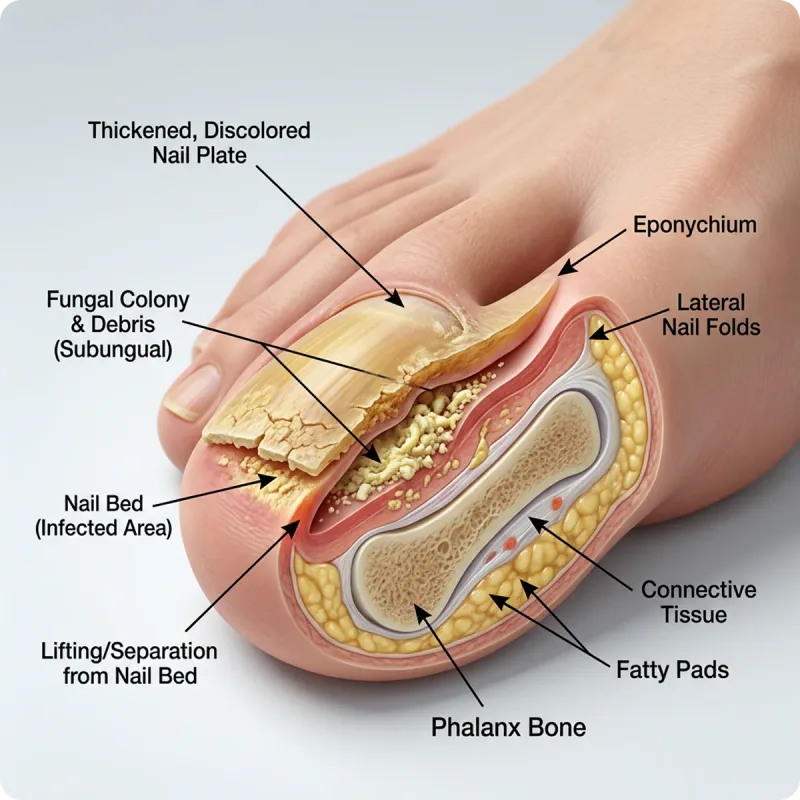
A toenail that turns yellow and thick doesn’t announce itself. It starts as a pale patch at the tip, then a bit of crumbling at the edge, then one day you realize you have been hiding that toe in sandals season. The good news is that the list of likely causes is short, the signs are fairly easy to read, and there is a sensible order of things to do. Here it is.
The quick answer
The most common reason a toenail turns yellow, thick and crumbly is a fungal infection of the nail (onychomycosis), which lives under and inside the nail and spreads slowly from the edge. Other causes include injury, polish staining, age and a few health conditions. A fungal nail rarely clears on its own; it responds to consistent daily care applied where the fungus lives, and severe or painful nails should be seen by a doctor.
1. Nail fungus: the usual suspect
Fungi love warm, damp, dark places, which describes the inside of a shoe perfectly. Once they get under the free edge of the nail or through a tiny crack, they settle into the nail bed, where the nail plate shields them from almost everything you put on top. That is why the classic signs develop slowly and from the outside in:
- Color change — yellow, white, brown or chalky patches, usually starting at the tip or one side.
- Thickening — the nail gets harder to trim and may look raised or ridged.
- Crumbling and brittleness — the edge flakes or breaks instead of clipping cleanly.
- Lifting — the nail separates slightly from the bed, with debris building up underneath.
- Spread — more of the same nail over months, and sometimes neighboring nails.
Risk goes up with age, sweaty feet, tight shoes, shared showers and locker rooms, athlete’s foot (the same kind of fungus on the skin), and conditions that affect circulation or immunity.
2. Injury: the thick nail with a history
A dropped weight, a long hike in tight boots, years of running — repeated pressure or a single hard knock can damage the nail matrix and leave a nail that grows in thick, ridged or discolored for a long time. The clue is usually a memory: there was an injury, and the nail has looked different since. A badly damaged nail can also give fungus an easy way in, so the two often show up together.
3. Polish and products: the yellow that scrubs off
Dark polish worn for weeks, especially without a base coat, can leave a yellow stain on the nail plate. The tell is that the nail is smooth and normal thickness, the staining is fairly even, and it grows out or fades once the polish is left off. It looks alarming and is mostly harmless.
4. Age and simple wear
Nails grow more slowly with age and tend to thicken, dull and ridge. That alone does not mean fungus, but a slower-growing, thicker nail is also easier for fungus to colonize, which is one reason fungal nails are so common after 60.
5. When a yellow nail means something else
A handful of skin and health conditions also change nails: psoriasis can pit and thicken them, poor circulation and some lung conditions are associated with yellowed nails, and a dark streak or spot under a nail that didn’t come from an injury always deserves a doctor’s look. Use this simple rule: a nail that changes suddenly, is painful, bleeds, is hot or swollen, or shows a dark streak, gets seen by a professional. Likewise if you have diabetes or circulation problems, since foot problems carry more risk.
How to tell what you are dealing with
| Sign | Fungal nail | Injury | Polish stain |
|---|---|---|---|
| Where it starts | Tip or side, spreads inward | Whole nail after an event | Even across the surface |
| Thickness | Gets thicker over time | Thick from the start | Normal |
| Texture | Crumbly, brittle edge | Ridged, may lift | Smooth |
| Trend | Slowly worse without care | Grows out over months | Fades when polish is left off |
What actually helps a fungal nail
- Keep the nail short and cleanTrim straight across, file down thick areas gently, and keep the free edge short so there is less nail for fungus to hide under.
- Apply something every day, on the nail and under the edgeThe fungus lives under the nail plate, so whatever you use has to reach the edges and the free edge, not just the surface. Twice-daily application, for weeks, is the pattern that matters.
- Dry feet, breathable shoes, clean socksChange socks daily, alternate shoes so they dry out, use flip-flops in shared showers, and treat athlete’s foot if you have it so it doesn’t keep reseeding the nail.
- Be patient and track from the baseA clear nail grows in from the base and pushes the damaged part out. On a big toe that takes months. Photograph the nail every couple of weeks so you can see the trend.
- See a doctor for severe, painful or spreading nailsPrescription options exist for nails that are badly involved, and a professional can confirm it really is fungus.
The routine we recommend for everyday discolored nails
For the common case — a yellow, thick or brittle nail you want to look after at home — the hard part is step 2 above: doing it every day. That is why we like the Fungabeam Pen. It is a twist-and-brush pen that puts a plant-based formula with tea tree leaf oil, lemon juice, aloe and vitamin E exactly on the nail, along the edges and under the free edge, in seconds, with no greasy residue. The maker recommends twice-daily use, says it is designed for thick, discolored nails, and reports that some users notice the appearance improving within 5 to 7 days. It is sold in packs from $13.99 per pen with a 30-day money-back guarantee. It is a cosmetic nail-care product, not a medicine, so the doctor rule above still applies.
Frequently asked questions
What does nail fungus look like?
Typically a nail that turns yellow, white or brown, thickens, becomes crumbly or brittle at the edge, and may lift slightly from the nail bed. It usually starts at the tip or side of the nail and spreads toward the base over months. The big toenail is the most common place.
Can a yellow toenail be something other than fungus?
Yes. Dark polish worn for weeks can stain the nail yellow, an old injury can leave a thickened nail, and some skin and health conditions change nail color too. If a nail changes color suddenly, is painful, or dark streaks appear, have a doctor look at it.
Will a fungal toenail go away on its own?
Rarely. Fungus lives in the nail bed and under the nail plate, where it is protected, so the usual pattern without any care is slow spread to more of the nail and sometimes to other nails. Consistent daily care, and a doctor’s help for severe cases, is what changes the trend.
This article is general information, not medical advice. If a nail is painful, bleeding or infected, or if you have diabetes, circulation problems or a weakened immune system, see a healthcare professional.