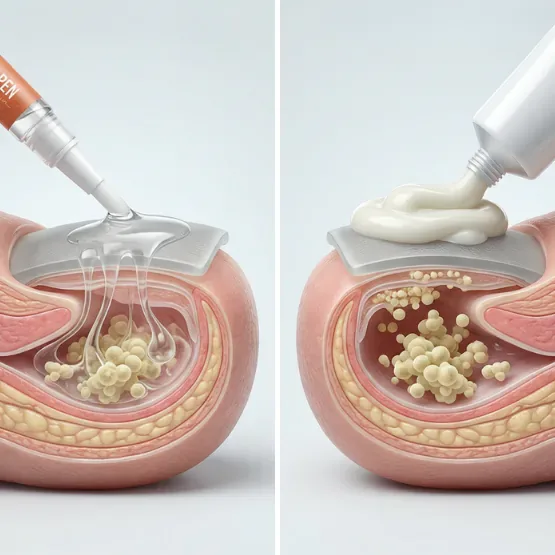
Search for help with a yellow, thick toenail and you get three families of answers: a brush-tip pen, a tube of cream, or a trip to the doctor for a prescription. Each is good at something different, and the right one depends less on the ingredient than on your nail and your ability to keep up a routine. Here is a clear look at all three.
The quick answer
Use a prescription when a nail is badly involved, painful or spreading, or when you have a health condition that makes foot problems risky. Use a cream for fungus on the skin around the nail. For the common case — a discolored, thickened nail you want to look after every day at home — a brush-tip pen is the easiest to apply precisely, the cleanest, and the one most people actually keep using.
Prescription treatments: powerful, with trade-offs
A doctor can prescribe oral antifungal tablets or a medicated nail lacquer. Oral treatment reaches the nail from the inside and is the strongest option for severe nails, but it is taken for months, needs monitoring, and is not suitable for everyone. Prescription lacquers are painted on daily for many months. This route makes sense for nails that are mostly involved, painful or spreading, and for anyone with diabetes, circulation problems or a weakened immune system — those cases should start with a professional, not a pen.
Over-the-counter creams: cheap, familiar, messy
The classic tube from the pharmacy. Creams are inexpensive and good for fungus on the skin (athlete’s foot between the toes or on the sole). Their weakness is the nail: cream spreads across the toe, most of it ends up on skin rather than under the nail edge where the fungus lives, it feels greasy, and the hand-washing and waiting make it the easiest routine to skip. Many people use a cream for a week or two and quietly stop.
Brush-tip nail pens: made for the nail
The newer category puts a liquid formula in a slim pen with a soft brush. You twist the base, brush the formula onto the nail surface, along the edges and under the free edge, and you are done in seconds. It dries quickly with no residue and lives in a pocket or bag. Over-the-counter pens are cosmetic nail-care products aimed at the appearance of discolored, thickened nails — not prescription medicines — but the format solves the thing that defeats most home routines: precision and consistency.
Side by side
| Brush-tip pen | OTC cream | Prescription | |
|---|---|---|---|
| Best for | Everyday discolored, thick nails | Fungus on the skin | Severe, painful or spreading nails |
| Where it goes | Nail, edges, under the free edge | Over the whole toe | Inside (oral) or on nail (lacquer) |
| Time per use | Seconds | A minute plus hand-washing | Daily for months; doctor visits |
| Mess | None; dries fast | Greasy | Low |
| Easy to keep up | High — pocket-size, leak-free | Low — easy to skip | Medium — monitoring needed |
| Cost | About $14–$20 per pen | Low | Varies; visits and tests |
| Safety notes | Cosmetic product; see a doctor for severe cases | Follow label | Needs medical supervision |
Which one should you choose?
- Painful nail, most of the nail involved, several nails, or a health condition? Start with a doctor. That is what prescriptions are for.
- Itchy, peeling skin between the toes? A cream for the skin, and keep feet dry.
- One or a few nails that are yellow, thick or brittle, and you want a routine you’ll keep? A brush-tip pen, twice a day, for weeks, with the nail trimmed short. Photograph the base every couple of weeks to track the new growth.
Whatever you choose, the common thread is the same: fungus lives under the nail plate, so the product has to reach the edges, and it has to be applied every day for long enough for a new nail to grow in. (See how long a toenail takes to grow out for the realistic timeline.)
Our pick for the everyday case
The brush-tip pen we recommend is the Fungabeam Pen. It is a 3 mL twist-and-brush pen with a plant-based formula — the box lists tea tree leaf oil, lemon juice, aloe leaf juice and vitamin E — that absorbs quickly with no greasy residue. The maker directs twice-daily use on clean nails, positions it for thick, discolored nails and for several nails at once, and reports that some users notice the appearance improving in 5 to 7 days. On the official site it costs $19.99 for one pen or $13.99 each in the six-pack, with a 30-day money-back guarantee and shipping to the US and Canada.
Frequently asked questions
Do nail fungus pens actually work?
A pen is a delivery format, not a magic ingredient: it puts a liquid formula on the nail and under its edge precisely, with no mess, which makes twice-daily use far easier to keep up. Over-the-counter pens are cosmetic nail-care products aimed at the appearance of discolored, thickened nails; they are not prescription medicines. Consistency over weeks is what determines results with any topical option.
Is a cream or a pen better for toenail fungus?
For the nail itself, a brush-tip pen usually wins on precision and consistency: the formula goes on the nail and under the free edge instead of over the whole toe, it dries fast and it travels. Creams are cheap and familiar but greasy and easy to skip. For fungus on the surrounding skin (athlete’s foot), a cream is the right tool.
When should I see a doctor instead of treating a nail at home?
When the nail is painful, bleeding, hot or swollen; when most of the nail or several nails are involved; when a dark streak appears; when nothing has changed after months of consistent care; or if you have diabetes, poor circulation or a weakened immune system. A doctor can confirm the diagnosis and discuss prescription options.
This article is general information, not medical advice. If a nail is painful, bleeding or infected, or if you have diabetes, circulation problems or a weakened immune system, see a healthcare professional.